The short answer: in the most-cited public chart, AI is already a meaningful minority of the winners.
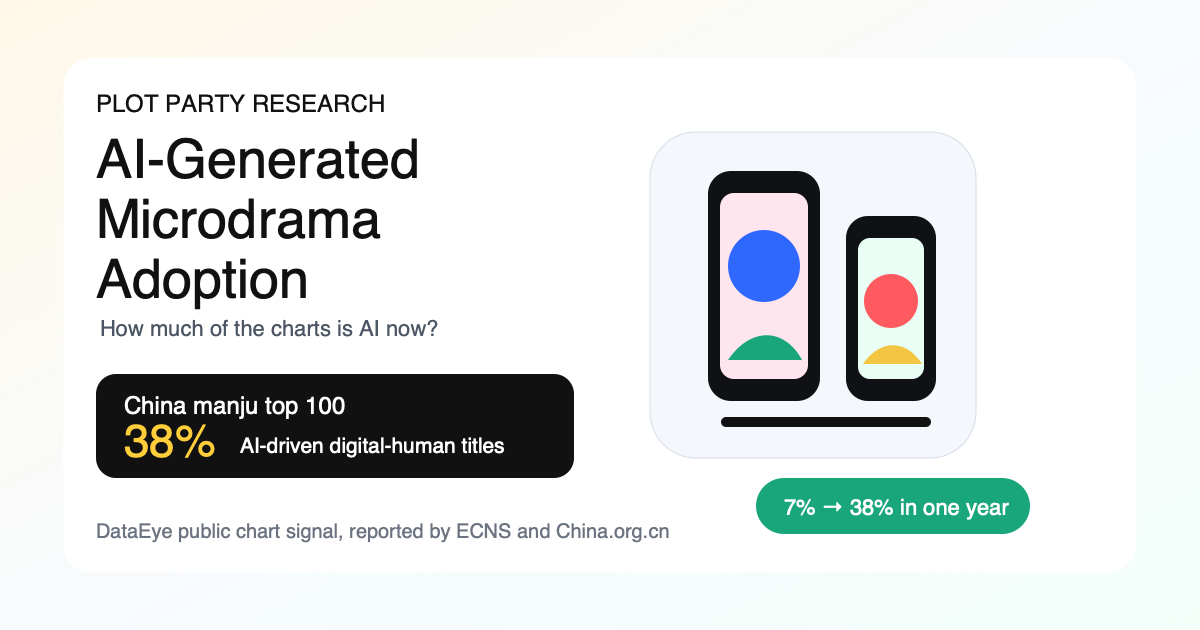
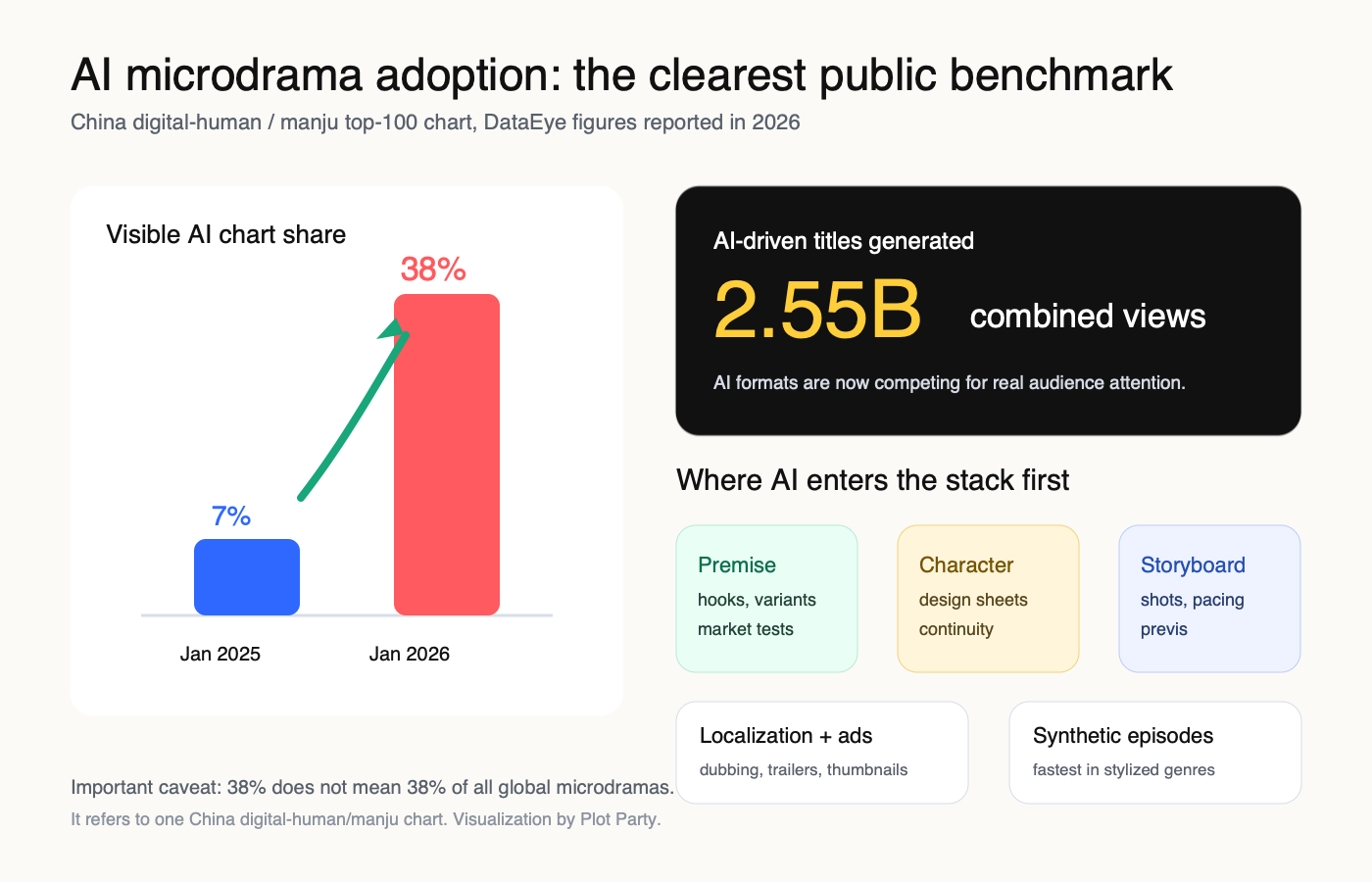
DataEye's China short-drama tracking, reported by ECNS and China.org.cn, found that AI-driven digital human dramas accounted for 38% of the top 100 "manju" titles in January 2026, up from 7% a year earlier. Those AI titles generated a combined 2.55 billion views on the January chart.
That number is important. It is also easy to misuse.
It does not mean 38% of every global microdrama chart is fully AI-generated. It refers to a China-centered "manju" or digital-human/comic-style short drama ranking, where animated and virtual-human formats are naturally more AI-friendly than live-action romance microdramas.
Still, it is the clearest public benchmark we have. The signal is hard to ignore: AI microdrama has moved from novelty into chart competition.
The Adoption Snapshot
Here is the current picture:
| Market Signal | What It Suggests |
|---|
| 38% of top 100 manju titles in January 2026 were AI-driven digital human dramas | AI is already charting in China where virtual-human and comic-style drama formats are mature |
| 7% one year earlier | The shift happened fast, not gradually |
| 2.55B combined views for AI-driven titles on that January chart | Audiences are not only tolerating AI formats; they are watching them at scale |
| Vigloo plans roughly 30% of its 2026 slate through AI-driven studio workflows | Overseas platforms are beginning to operationalize AI as a production strategy |
| Netflix disclosed generative AI use across roughly 300 productions in 2026 | The AI production shift is not limited to microdrama or China; it is entering mainstream studio pipelines |
For creators, the takeaway is not "AI has won." The better reading is:
AI is becoming a production layer. In some microdrama subcategories, it is already a chart layer.
What Counts as "AI-Generated"?
Before asking how much of the chart is AI, we need to define the label.
In practice, "AI-generated microdrama" can mean at least five different things:
AI-assisted script development
Writers use AI for hooks, beat sheets, dialogue variations, localization, or episode pacing.
AI-assisted production
Human actors and crews still shoot the series, but AI helps with previsualization, storyboards, background replacement, VFX, cleanup, and editing.
AI post-production and localization
AI handles dubbing, subtitles, lip sync, voice adaptation, music, sound design, or versioning across languages.
AI animation or digital-human production
Characters, shots, voices, and environments are produced through AI-generated animation, digital human tools, or hybrid virtual-production workflows.
Fully generative microdrama
The title is largely created from text, image, character, and scene inputs, with humans directing, selecting, reviewing, and assembling the output.
These are very different production realities. A live-action CEO romance with AI subtitles should not be counted the same way as an AI digital-human fantasy series. A platform can truthfully say "AI was used" even when the viewer sees a conventional live-action show.
That is why the most useful question is not just:
How much of the chart is AI?
It is:
Which part of the production stack is AI, and is AI visible to the audience?
The 38% Number: What It Really Means
The strongest public adoption number comes from China.
ECNS reported in February 2026 that DataEye data showed AI-driven digital human dramas accounted for 38% of the top 100 "manju" titles in January 2026, up from 7% a year earlier, with combined viewership of 2.55 billion views for those AI-driven titles.
China.org.cn separately reported that AI-generated comic-style microdramas had reached an estimated 16.8 billion yuan in market value in 2025, while DataEye expected that segment to exceed 30 billion yuan in 2026.
This is not a fringe experiment. It is a commercial category.
But it is also not the whole microdrama industry. The chart is tied to "manju," a category closer to animated, comic-style, or digital-human serialized drama. That matters because AI is strongest where the format already accepts stylization:
- Digital humans
- Anime-inspired characters
- Fantasy worlds
- Webtoon-style adaptations
- Supernatural and game-like settings
- Rapidly versioned genre premises
In traditional live-action microdrama, AI adoption is more likely to be hidden inside the workflow first: script iteration, localization, ad creatives, scene planning, VFX, and trailer generation. The viewer may not identify the result as "AI-generated," but the production economics still change.
Why China Is the First Place to Watch
China is the right market to watch because it combines three conditions that make AI adoption faster.
1. Extreme volume
Microdrama is already industrialized in China. Teams are used to fast scripting, fast shooting, fast testing, fast iteration, and fast replacement when a title underperforms. AI fits naturally into that operating rhythm.
2. Audience familiarity with synthetic formats
Digital humans, virtual idols, webtoon adaptations, and animated short-drama styles are already part of the entertainment language. That lowers the adoption barrier compared with markets where audiences expect live-action realism.
3. Chart pressure
When a category rewards high output, quick trend response, and low production cost, AI does not need to be artistically perfect on day one. It needs to produce enough quality at enough speed to test more concepts.
That is the central economic reason AI microdrama is moving quickly: the format rewards iteration.
Why Global Adoption Looks Different
Outside China, the AI microdrama story is less about public chart share and more about production pipelines.
Vigloo is the clearest example. The Korean short-drama platform has been rolling out AI-driven production experiments and, according to C21Media and the Los Angeles Times B2B coverage, planned to produce roughly 30% of its 2026 annual slate through AI-driven studio workflows, including animation. Its AI-made vertical drama work points to a hybrid model: small teams, compressed timelines, AI-driven visuals, and human creative supervision.
That is probably the near-term global pattern:
- Platforms test AI titles in animation, fantasy, YA, horror, and genre concepts first.
- Live-action romance keeps using AI mostly behind the scenes.
- Marketing teams use AI heavily for ad variants, trailers, thumbnails, dubbing, and localization.
- Creators use AI to move from pitch to episode faster, even when the final style is not fully synthetic.
In other words, the global chart may not suddenly become "38% visibly AI" across all microdrama apps. But the production stack behind the chart will become AI-heavy very quickly.
Why AI Fits Microdrama So Well
AI video still struggles with long continuity, subtle performances, and complex physical interactions. Microdrama, oddly enough, gives it a friendlier production target.
Microdramas are:
- Short episode by short episode
- Built around clear emotional beats
- Driven by recurring genre formulas
- Optimized for mobile framing
- Heavy on dialogue, reveals, reactions, and cliffhangers
- Easy to test through thumbnails, hooks, and short ad creatives
That does not make microdrama easy. Good microdrama requires ruthless pacing and strong emotional logic. But it does mean the work can be divided into small, testable units.
AI can help with:
- Generating premise variations
- Building character bibles
- Writing episode outlines
- Producing first-look character art
- Creating storyboard frames
- Testing hooks and cliffhangers
- Localizing dialogue
- Versioning ads for different markets
- Generating synthetic shots that would be too expensive to shoot
The most valuable AI use is not replacing every human decision. It is expanding the number of story decisions a small team can test.
The Chart Share Will Not Move Evenly
Expect AI adoption to split by genre and format.
Fastest AI adoption
- Animated romance
- Fantasy and supernatural drama
- Digital-human melodrama
- Anime/webtoon adaptations
- Sci-fi and game-world stories
- Horror concepts with stylized visuals
- Low-cost local-language experiments
Slower visible AI adoption
- Live-action billionaire romance
- Family melodrama
- Workplace revenge
- Realist contemporary drama
- Talent-led creator series
- Titles where audience trust depends on actor chemistry
The line is not quality. It is audience expectation. If the audience already accepts a stylized world, AI can be visible. If the audience came for actor chemistry and realism, AI will first appear as invisible infrastructure.
For platforms, AI changes supply.
The old bottleneck was production capacity: crews, locations, actors, schedules, localization, and budget. The new bottleneck is selection. If AI makes it cheaper to produce 20 versions of a premise, the platform still needs to know which one deserves distribution.
That makes data more important, not less important.
Platforms will likely use AI to:
- Produce more pilots and concept tests
- Localize winning shows faster
- Create market-specific versions of ads and thumbnails
- Expand genre coverage without expanding headcount at the same rate
- Revive or remix older IP into vertical formats
- Reduce the cost of risky experiments
The winners will not be the platforms that generate the most content. The winners will be the platforms that identify the strongest emotional hooks fastest.
What This Means for Creators
For creators, AI lowers the cost of trying.
That matters because microdrama is a format where many ideas fail quickly. A premise that looks strong in a pitch can die in the first three episodes. A character can look good in a poster but fail to create unlock desire. A cliffhanger can be technically clear but emotionally weak.
AI lets creators prototype before committing to a full production.
A creator can test:
- Does the revenge setup land?
- Is the hidden-identity reveal clear?
- Does the protagonist have a strong enough wound?
- Does the couple have visual chemistry?
- Can the story sustain 60 episodes?
- Which thumbnail or opening moment creates the strongest click?
- Which version works in English, Spanish, Indonesian, or Thai?
That is why Plot Party focuses on story, characters, scenes, and production flow together. AI microdrama is not just a video-generation problem. It is a serial-story workflow problem.
The Better Forecast: AI-Native, Not AI-Only
The future of microdrama is probably not a clean split between human-made and AI-made.
It will look more like this:
| Layer | Likely AI Adoption |
|---|
| Premise testing | Very high |
| Character design | Very high |
| Script iteration | Very high |
| Storyboards and previs | Very high |
| Localization | Very high |
| Ad creatives | Very high |
| Backgrounds, VFX, and pickups | High |
| Full synthetic episodes | Medium, rising fastest in stylized genres |
| Actor-led live-action performance | Lower, but AI-assisted |
So when someone asks, "How much of the charts is AI now?" the honest answer is:
Visible AI is already around 38% in one important China digital-human/manju top-100 chart. Globally, the visible share is lower and less consistently measured, but AI assistance behind the scenes is becoming common across the production stack.
The chart number will keep rising, but the bigger shift is quieter: AI will become the default way microdrama teams plan, test, localize, and scale.
The Creator Opportunity
The first wave of AI microdrama was about novelty: "Look, this was made with AI."
The next wave will be about performance: "This keeps people watching."
That is a very different standard. Audiences do not pay because a workflow is clever. They pay because the next episode promises a feeling they want: revenge, relief, recognition, romance, shock, justice, or belonging.
AI can make production faster. It can make experiments cheaper. It can help small teams compete with studios. But the chart still rewards emotional precision.
For creators, the opportunity is not to make generic AI content. It is to use AI to become better at microdrama fundamentals:
- Sharper hooks
- Clearer character desire
- Stronger episode turns
- Better cliffhangers
- More consistent characters
- Faster localization
- More testable story variants
That is where AI microdrama becomes more than a trend. It becomes a new production grammar.
Ready to build with that grammar? Start creating on Plot Party, or read our complete guide to creating an AI microdrama.
Sources
FAQ
Are 38% of all microdramas AI-generated now?
No. The 38% figure refers to AI-driven digital human dramas in a January 2026 China "manju" top-100 chart reported from DataEye data. It is an important adoption signal, but it should not be treated as the global share of all microdramas.
Is AI adoption higher in China than overseas?
Visible AI adoption appears higher in China, especially in digital-human, comic-style, and animated short-drama categories. Overseas markets are adopting AI heavily in workflow areas such as localization, ad creative, story development, and synthetic production tests.
Will AI replace live-action microdramas?
Not entirely. AI will replace some low-budget synthetic and stylized production, but live-action microdrama still benefits from actor chemistry, recognizable faces, and realism. The more likely future is hybrid production.
What is the biggest opportunity for creators?
The biggest opportunity is faster testing. AI lets creators prototype premises, characters, scenes, hooks, and localized versions before committing to a full production budget.